Wednesday, April 3, 2013

Bank Training & Professional Development

How did we ever get somewhere we hadn’t been before without Google Earth or a GPS?  Oh, I remember, we used a map -- those impossible to refold paper maps that had a scale so you could take a ruler and mark up your route and measure your distance.  Now that’s really dating me.  Even my plug in the cigarette lighter Garmin is old hat.  Today, my Smartphone acts as my guide, navigating me here and there.  I really like it when the navigator alerts me when there are tolls so I can be ready to fork over my quarters or dollars and pay the price to travel the best route.  

When it comes to training, set your sights on your destination, map out the route and pay the toll.  Clear a path for training to become a rock solid contributor to your culture, efficiencies and bottom line.


Everyone invested in your bank hopes that the staff – from top to bottom - is well-trained.  Are you using hope and luck as your strategies for making training a priority or do you enjoy the comfort that comes with needs assessment, goals and a plan?  I am sure you would agree you need to rely on more than hope when it comes to people knowing how to do their job so that the bank can build a well-earned reputation for excellence among customers, regulators, peer, investors and the community.

Let me ask you this, at times do you find yourself thinking we sure are lucky that we have people who know what to do and how to do it?  Certainly, being grateful for the talent and skills of the staff is admirable and a best practice when expressed. However, should the hope and luck strategies crash, you will be even more grateful you aren’t working in a hospital!  Why wouldn’t the bank want to take the same stance as a hospital or a well-run restaurant when it comes to training?  Training is about preventing problems, solving problems, enhancing confidence and building collective and individual intelligence.

It’s interesting that there is a mandate for a bank to have a disaster recovery plan but not a plan for training and developing the staff.  Maybe now is the time to issue that mandate and ensure training and professional development become a top priority at your bank.  How do you do that?  Where do you begin? 
 
Join me in my next blog for more training direction!
 
Still learning,
 
Honey

Sunday, March 31, 2013

Need an Attitude Adjustment? Go Pro!


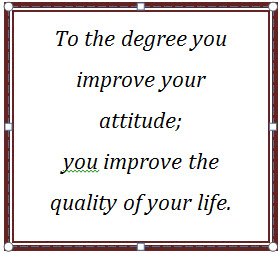
Our attitude shapes our environment – it’s the difference, to use a cliché, of seeing the glass as half full or half empty.  Our outlook on life is the road map that guides the quality of our lives.  A simple way to look at attitude is this:  Attitude is the way we communicate how we’re feeling to other people. 

Positive, optimistic people exude a favorable attitude that draws like-minded people toward them. It’s just natural to want to be around people who have an uplifting influence, who don’t pepper most conversations with negative remarks. When we are pessimistic and continually expect life to be negative, we put up a barrier to other people.  And, the ones we attract are the grim reapers of the world.  Those with nothing kind to say and those that think things are bad and that things are only going to get worse.

Attitude is shaped in our mind, it’s the way we look at things, circumstances, people...it’s our perspective. We’re in control of our perspective so we are in control of our attitude. 


Life is very challenging and it is naïve to think we can be 100% positive 100% of the time. Excessive optimism can appear false and may, in fact, at times be inappropriate.  

When things are going well, it’s much easier to maintain a healthy outlook.  The challenge comes when something happens to test our positive perspective.  

The difference between a positive and negative person is the positive person knows that she or he will bounce back, that whatever the situation, they will not be bogged down in it forever.


Why is attitude so important to delivering customer service?
Customer service super stars know that managing their attitude helps ensure they have a stellar performance.  Super stars get on purpose and become committed to excelling at performing  (just like actors in a movie or a play).  They know their lines, they are dressed the part and are well-rehearsed.  Even when life hands them a hard knock they act the part they are expected to play.  In sports they call this "sometimes you have to play hurt". The game must go on .  

Another thing customer service professionals, like bank tellers, new account representatives, and call center agents have learned is this - act your way into a new attitude.  
  • When you don't feel good, act like you do and you'll feel better.  
  • If your heart aches because of a broken or troubled relationship, kick up your acting a notch and you'll feel better.
  • The next time your are suffering with disappointment or disillusionment, change your focus to what you have to be grateful for and you'll better.   

What is the lesson in this?  Go pro.  Never forget that attitude is important to the quality of every aspect of your life.  The pros know that you have to focus on both your attitude and your performance.  If either one is in need of an adjustment, take full responsibility to change what you are thinking or what you are doing to get the results you are after.  When need be, adjust both!

Still learning,

Honey


Wednesday, March 27, 2013

Hot Tips for Training Others at Your Bank


Take Control of the Training Room Right Away

If you are committed to being effective at training others at your bank or credit union, here are few hot tips for you.  Whether you are training one person or fifty, lay the ground rules in your training environment first thing.  Solicit input from attendees about what they think are best practices that make for an excellent training environment.  Post the results on a flip chart or whiteboard for everyone to see throughout the training event.

Here is a starter list...keep the to about ten or so.

1.   Cell phones off or on vibrate.
2.   Check messages at breaks.
3.   No texting during class.
4.   Participate willingly.
5.   Be on time for class and when breaks are done.
6.   Answer questions.
7.   Have fun. 

Learn more about excelling at trainer bankers

Stay Tuned to What You See
Be observant and respond to what you see by taking action that keeps the trainee's interested. Watch for signs they aren't "getting it" or, they need a break.

Behaviors
What It May Mean
Smiling
Nodding affirmatively
Leaning forward
Making eye contact

Enthusiasm, Interest, Understanding
Yawning
Vacant stare
Shuffling feet
Leaning back in chair
Looking at clock

Boredom, We need a Break, Get Me Out of Here!

Frowning
Scratching head
Pursing lips
Vacant stare
Avoiding eye contact

Confusion, I'm lost, I need help


Still learning,


Honey

Saturday, March 23, 2013

The Bank Teller & The Bank Secrecy Act


Since inception, the Bank Secrecy Act’s impact on the teller position has been, in large part, about complying with the regulation’s requirement to report and/or maintain information on certain cash transactions.  Your financial institution will provide you with required Bank Secrecy Act training.  Use this checklist to verify your expertise.


Bank Secrecy Act Checklist for Tellers
Question
Yes/No
The teller can explain how BSA impacts work on the teller line

The teller is aware of who at the company can provide guidance on BSA

Training has been provided for the teller on the following:

·        The distinction between placing a hold and sending an item for collection

·        The company’s Customer Identification Program (CIP)

·        Rules that impact cash transactions specifically:

  • $3,000 Monetary Instruments rule

  • Greater than $10,000 Currency Transactions rule

  • Suspicious Structuring of Cash

How to complete work expected of the teller that relates to the rules

How to discuss following the rules, when applicable, with the customer

How to handle uncooperative customers when obtaining required information for BSA reporting

Identifying and reporting suspicious activity for any combination of transactions that are not “the norm”


This is just an example of the types of training tools you will find in our Essential Teller Issues manual.  Click right here, right now,  to order one for each of your tellers.  Train them, coach them and raise the bar on the teller line!

Still learning,

Honey

Thursday, March 21, 2013

Tellers Look the Part!


Manage Your Image

Your image is created by what people see, sense, hear and read about you.  Choose wisely in creating the image you want to have.
 

  • What you wear sends a powerful message to others. 
  • Dress the way you want to be perceived. 
  • Your body language, especially your posture and attention to grooming details, will convey confidence.
  • How you communicate verbally and in writing will reinforce or erode your professional maturity. 

Know the dress code at your company, be a true role model.  

More and more, the dress code is business-casual.  In establishing a business-casual dress code, employees are allowed to work comfortably. However, a professional image cannot be sacrificed for comfort.  So, it's necessary that business casual clothes still uphold a high level of professionalism.


Order each of your tellers the
Go to the store, click here.
It is full of excellent training including all the how to regarding
balancing, 
professional maturity,
scrutinizing transactions and more.

 Tips for Business-Casual Dressing


1.     Observe those responsible for enforcing the dress code to help clarify the policy.

2.     Wear clothes that are well ironed, neat and well-fitted.  Do not wear wrinkled and untidy clothes to work.  Clothes should not be too tight or too loose.

3.     Do not compromise on the quality of the business-casual dress attire. Poor quality clothing shows wear quickly and will appear washed out or worn.

4.     Hair and facial hair should be well groomed.  Include your nails in the grooming process.

5.     When wearing skirts, women should make sure that they are not revealing when seated.

6.     Men should wear dark colored socks to a length that does not show their skin when seated.

7.     Watch out for what’s considered the latest fad in dressing such as flip flops, low-cut tops and jeans with short zippers that are skin tight or drag the floor.  These fads may be “in” but are not acceptable at work.

Still learning,

Honey


Sunday, March 17, 2013

Training Bank Tellers - Detecting Kiting


Check kiting is a form of fraud involving moving theoretical funds between two or more checking accounts.  A check written to the criminal from one bank is deposited, and more importantly credited, to an account at a second bank. Because that second bank now shows a positive balance, the criminal can withdraw enough money to deposit back into the first bank before the check bounces for lack of funds.

This form of check kiting may seem to be too complicated for such a small payoff, but flipping the funds back and forth between accounts can buy the criminal enough time to generate real money to cover any other outstanding checks.

Some people have been known to use this method, called payday kiting, when several checks on an overdrawn account may come due before a paycheck or other regular funds can be deposited. The payday kiting scheme depends on the bank's delay between receipt of deposits and checks and their eventual processing, also known as "float time."

When kiting takes place, the financial institution stands at risk.  If a kite goes undetected, the account holder may have numerous financial institutions involved.  When the kite stops "working," usually the last institution involved experiences a loss.

Here are steps to take to determine kiting and minimize risk:


Tighten the review process on all funds deposited by an account holder that include any item drawn on other banks that the depositor is the maker of the item, even if it involves a cashier’s checks or money orders where the remitter is the account holder.

Tellers are to alert management anytime

  • The size or frequency of these types of items exceed a certain conservative amount
  • When a quick review of the depositor’s account indicate withdrawals and deposits that are for the same amount.
 Place special instructions on the account to alert other tellers.

Contact the other institution(s) involved to confirm the funds are available, if not, refuse the check or send the check for collection.

Alert the compliance officer of suspicious activity.


Financial institutions lose millions of dollars annually as a result of kiting schemes.  The strongest method for deterring or stopping kiting is observant, alert tellers, and the aid of the computer to detail a list of all items presented for payment that are drawn against uncollected funds.

The institution would be well-advised to purchase "watch dog" software that overviews all potential kiting or to have a kite-watch procedure where all "not on us" items of an established amount (i. e., $5,000 or more) are placed in a review bin so a designated deposit review person gives these items a second look.  Centralizing the effort allows a few "specialists" to become very familiar with depositors moving money from one institution to another, amounts, frequency, etc.  Also, this approach allows tellers to work efficiently and reduces the need to slow transactions down delaying the account holder at the window, as well as others in line.

Stay tuned - more to come on training tellers. 
Still learning,


Honey


Wednesday, March 13, 2013

High Performing Branches - Installing a Sales Culture - Part 3


As expected, there are a number of elements necessary for a financial institution to have a fully integrated sales culture.  A financial institution with an entrenched sales culture knows that to create that culture at a high rate of speed you are looking at two years, at least.  Not only is the target constantly moving; the bar for achieving a fully integrated sales culture is always rising.

Many banks attempt to simply overlay new concepts over existing organizational structure.  The flaw in this is that it leaves existing thinking in place. In order to change a culture, you have to change thinking through role modeling, training and conveying expectations.  The decision to move towards a sales culture is the easy part.  Getting a strong majority on board and tirelessly executing the plan to deliver the results that a sales culture can provide is no doubt the hard part.  And, if getting there is hard, staying on top of a thriving sales culture is harder.

Get the Picture!
Executive management must have a true picture of where the institution is today and where it needs to be headed.  Establishing a clear picture of what a successful sales culture will look like is the foundation of success.  Everyone must get the picture.  Especially leadership in the branches, and, most definitely,  those leaders that the branch managers look to for direction.

Declare Victory Over Your Desired Outcome; Then Work Backward.
Community banks have the advantage of doing many things extremely well.  Know their customers in ways that bigger banks can only dream of; they genuinely serve the communities they serve and can traditionally respond quicker to the needs of the customer.  

Yet when it comes to building relationships with customers methodically, cross-selling a broad product range, and developing a true sales culture throughout their organization, community banks frequently lag in comparison to larger banks.

Vision, Values, Mission
It is critically important to have a clear vision of where the company wants to go and when it plans to get there. The CEO will need to sell and tell that vision, then require all responsible parties to contribute to developing a plan of attack to achieve the vision.  Another key to a sales culture is developing values that describe how everyone on the team will need to conduct themselves along the way. 

Lastly, a plan is written with measurable goals that are realistic, obtainable and are supported by clear strategies that ensure action is taken and monitored.   

That common bond that is formed from having a clear understanding throughout the company of what the vision and values are establishes the mission.   That mission is what creates a synergy and excitement that is evident in terms of camaraderie and results.


Still learning,

Honey